091-5813939 | 091-3069393 | +92 316 0789789 | +92 335 8789789 Mon-Fri: 8:00 AM - 10:00 PM
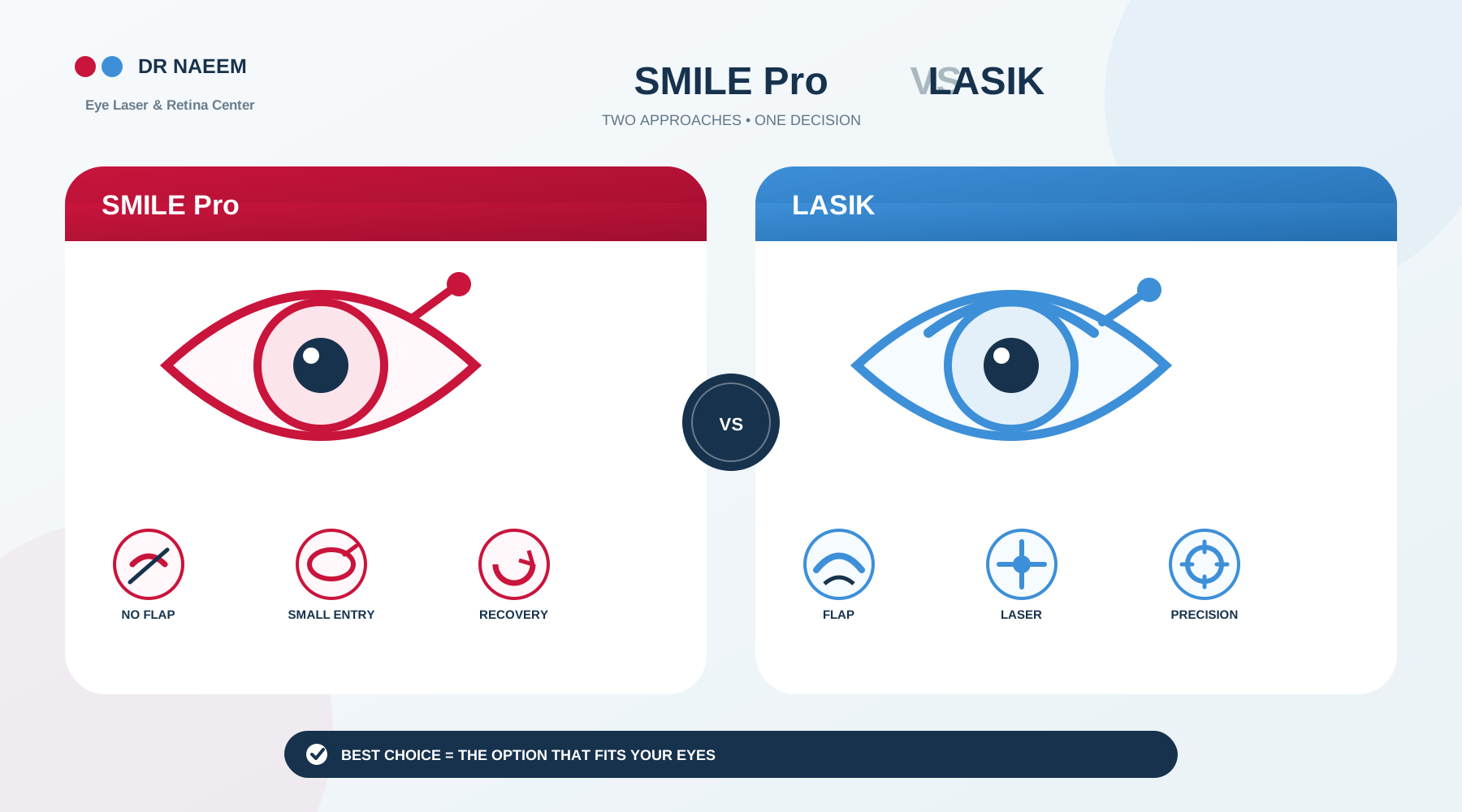
If you’re considering laser vision correction to reduce your dependence on glasses or contact lenses, two procedures you are likely to compare are LASIK and SMILE Pro. Both can provide excellent visual outcomes for appropriately selected patients, but they use different surgical techniques.
SMILE Pro is a flapless lenticule-extraction procedure performed using the ZEISS VisuMax 800, while LASIK uses a corneal flap followed by excimer-laser reshaping. Neither procedure is automatically better for everyone. The right choice depends on your prescription, corneal measurements, eye health, lifestyle, and the treatment options available for your eyes.
This guide compares SMILE Pro and LASIK across the factors that matter most to patients, including how they work, recovery, dry-eye considerations, treatment range, safety, cost, and candidate suitability.
Medically reviewed by: Prof. Dr. Naeem Khattak, Ophthalmologist & Eye Surgeon
Last medically reviewed: August 2026
SMILE Pro vs LASIK: Key Differences at a Glance
| Feature | LASIK | SMILE Pro |
|---|---|---|
| Corneal flap | Yes — a corneal flap is created and lifted during treatment | No — it uses a small incision to access and remove the lenticule |
| Main technique | Flap creation followed by corneal reshaping with an excimer laser | Lenticule creation and removal using a femtosecond laser |
| Laser systems | Typically uses a femtosecond laser for the flap and an excimer laser for corneal reshaping | Uses a femtosecond laser to create the lenticule and incision |
| Dry-eye considerations | Dry-eye symptoms are a recognized postoperative effect | Comparative studies generally find less early dry-eye impact than LASIK |
| Corneal nerves | Greater early disruption of corneal nerves can occur | Studies generally show less early nerve disruption than FS-LASIK |
| Laser treatment time | Varies according to the excimer laser and treatment parameters | ZEISS reports lenticule creation in less than 10 seconds on the VisuMax 800 |
| Treatment range | Can treat myopia and, with appropriate platforms, some hyperopia and astigmatism | Designed primarily for myopia with or without astigmatism within the applicable treatment range |
| Flap-related risks | Possible because a corneal flap is created | Not applicable because no LASIK-style flap is created |
| Long-term track record | Decades of clinical use and research | Newer than LASIK, with more than a decade of clinical experience with SMILE technology |
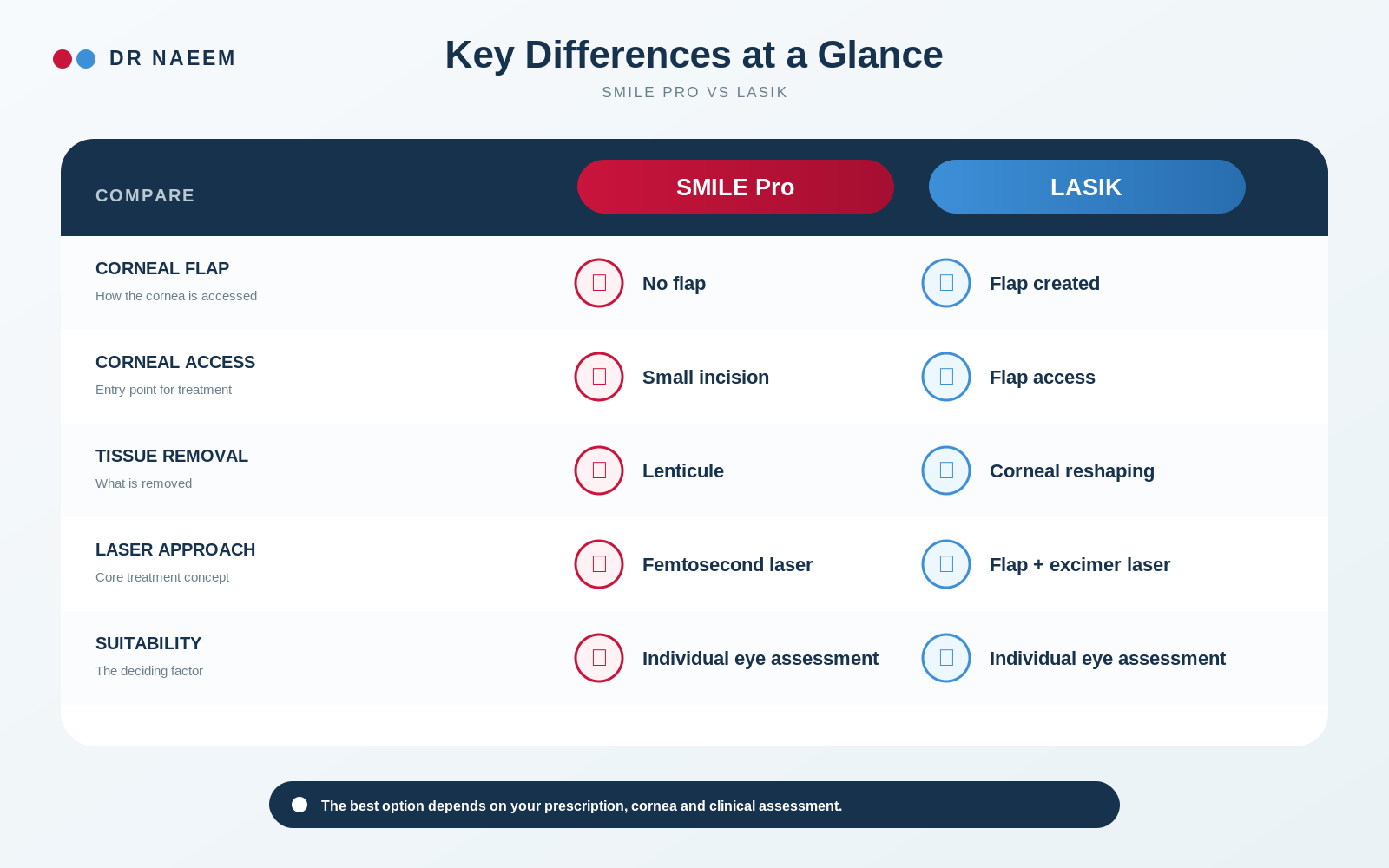
Quick answer: SMILE Pro may be attractive to patients who want a flapless procedure and may have a lower risk of early dry-eye symptoms, while LASIK can offer a broader range of treatment options depending on the patient’s prescription and the laser platform used. A detailed eye examination is needed before either procedure can be recommended.
How Does LASIK Work?
LASIK uses a femtosecond laser to create a thin, hinged flap in the cornea. The surgeon lifts the flap, uses an excimer laser to reshape the underlying corneal tissue according to the treatment plan, and then repositions the flap. The flap naturally adheres during healing and does not normally require stitches.
How Does SMILE Pro Work?
SMILE Pro uses the ZEISS VisuMax 800 femtosecond laser to create a small lens-shaped piece of tissue called a lenticule inside the cornea. The surgeon removes the lenticule through a small incision rather than creating and lifting a LASIK-style flap.
ZEISS reports that the VisuMax 800 can create a lenticule in less than 10 seconds and includes computer-assisted centration and cyclotorsion features designed to support the surgical workflow. The laser-treatment time is only one part of the overall procedure; preparation, docking, lenticule extraction, and postoperative checks also take time.
For a complete explanation of the procedure, see our complete guide to what SMILE Pro is and how it works.
Pain and Recovery: Is One More Comfortable?
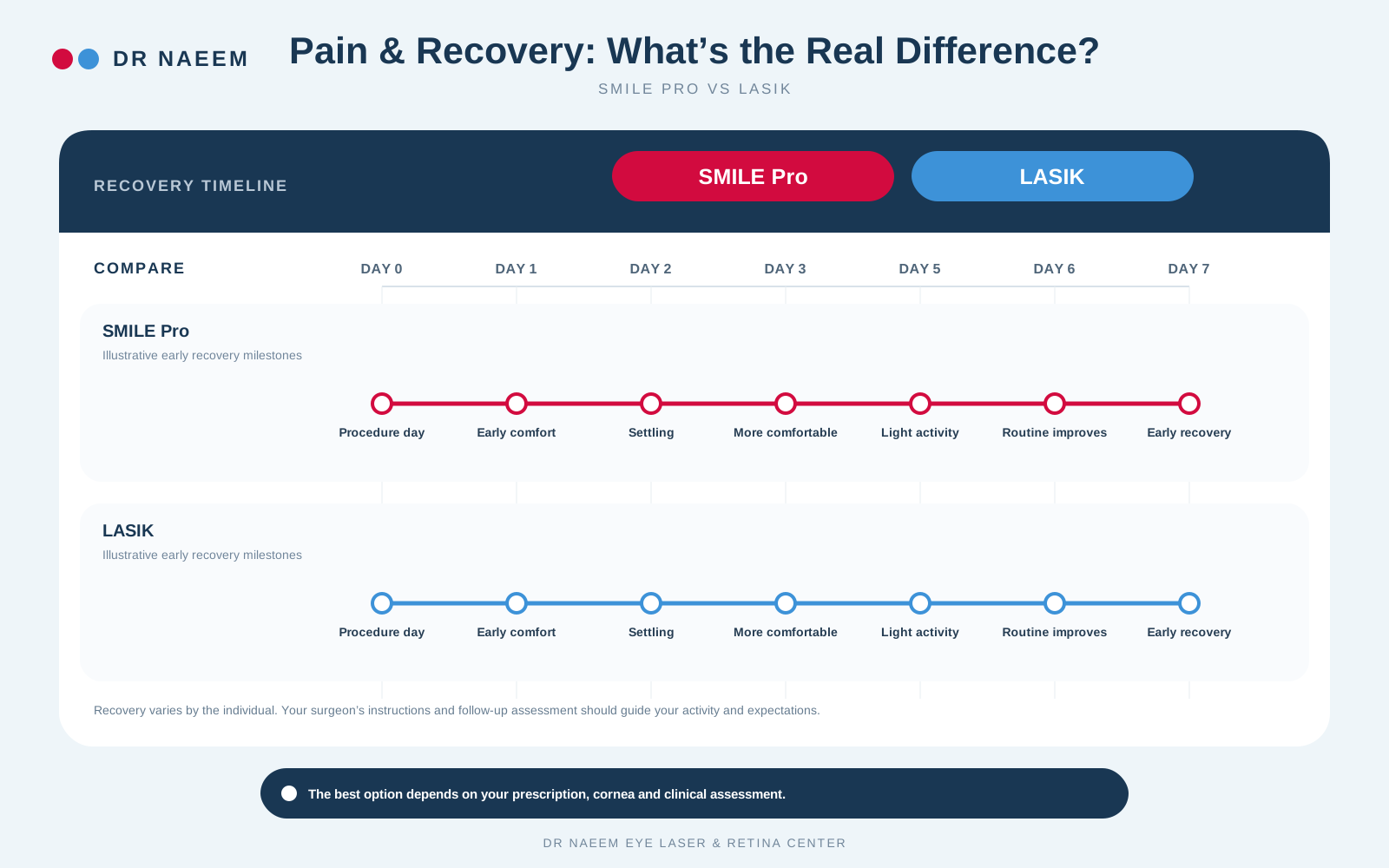
Neither procedure is typically described as painful during surgery because numbing eye drops are used. Patients may experience pressure or a temporary sensation while the eye is stabilized. Mild irritation, watering, light sensitivity, or a gritty feeling can occur after either procedure.
The early recovery experience can differ. LASIK involves a corneal flap, so patients receive specific instructions to protect the flap during the early healing period, including avoiding eye rubbing. SMILE Pro does not create a LASIK-style flap and may have a more comfortable early recovery for some patients, although individual healing varies.
Visual recovery is often rapid after both procedures, but the exact timeline depends on the patient’s eyes, prescription, treatment, and healing response.
Related: SMILE Pro Recovery Timeline — link this to the dedicated recovery article when it is published.
Dry Eye: Is SMILE Pro Better Than LASIK?
Dry eye is an important consideration when comparing laser vision correction procedures. LASIK can temporarily disrupt corneal nerves involved in sensation and tear-film regulation. SMILE also affects corneal nerves, but because it does not require a large flap, comparative studies generally show less early nerve disruption and better dry-eye-related outcomes than femtosecond LASIK.
A systematic review and network meta-analysis found differences in corneal nerve recovery between SMILE and femtosecond LASIK, while other comparative studies and meta-analyses have reported better tear-film or dry-eye measures after SMILE. These findings do not mean that SMILE Pro eliminates dry eye, and individual symptoms can still occur after surgery.
If you already have dry-eye symptoms, use contact lenses frequently, or spend long periods on screens, discuss your ocular-surface health with your surgeon before choosing a procedure.
Related: Dry Eye After SMILE Pro — link this to the dedicated article when it is published.
Which Prescriptions Can SMILE Pro and LASIK Treat?
The treatment range is one of the most important differences between the two procedures. LASIK can be used for myopia and astigmatism and, depending on the specific laser platform and regulatory indication, may also be used for some cases of hyperopia.
SMILE is primarily used for myopia with or without astigmatism within the applicable treatment range. For example, the current U.S. FDA labeling for the VisuMax system specifies particular ranges for myopia and astigmatism and requires stable refraction in the indicated patient population. Treatment ranges and approvals can differ by country and device, so patients should rely on their surgeon’s assessment and the applicable local indication rather than a generic online number.
Prescription alone does not determine suitability. Corneal thickness, corneal shape, ocular-surface health, overall eye health, and other clinical factors also matter.
For more detail, see our SMILE Pro Eligibility Guide or use our online eligibility check when available.
Which Is Safer: SMILE Pro or LASIK?
Both SMILE and LASIK have established clinical evidence and can provide good visual outcomes in appropriately selected patients. However, the procedures have different risk profiles.
LASIK has risks associated with creating a corneal flap, including flap-related complications. SMILE Pro does not create a LASIK-style flap, so those specific flap-related complications do not apply. On the other hand, SMILE has its own potential complications, including inflammation, infection, residual refractive error, visual symptoms, or difficulties during lenticule extraction.
Therefore, it is more accurate to say that each procedure has its own benefits and risks rather than calling one universally safer. The safest option for an individual patient is the procedure for which the patient’s anatomy, prescription, eye health, and treatment goals are appropriate.
Which One Should You Choose?
There is no single answer that applies to every patient. Instead of choosing a procedure based only on the newest technology or the shortest recovery claim, discuss the following factors with your ophthalmologist.
SMILE Pro may be considered when:
- You want a flapless laser vision correction procedure.
- Your main refractive error is myopia with or without astigmatism and falls within the applicable treatment range.
- Dry-eye risk is an important consideration for you and your ocular surface is suitable for surgery.
- You have an active lifestyle where avoiding a LASIK-style flap may be relevant to your discussion with the surgeon.
- Your corneal measurements and overall eye health are appropriate for SMILE.
LASIK may be considered when:
- Your prescription falls within the treatment range of the selected LASIK platform.
- You require treatment options that may include certain forms of hyperopia, depending on the applicable device indication.
- Your surgeon determines that the LASIK technique is appropriate for your corneal profile and treatment goals.
- You prefer a procedure with a very long history of clinical use and research.
Important: These are general considerations, not a way to self-select a procedure. A comprehensive eye evaluation, including corneal measurements and a review of your eye health, should guide the final decision.
Not sure which procedure is suitable for you? Book a comprehensive eye consultation to discuss your options.
SMILE Pro vs LASIK Cost in Pakistan
The price of laser vision correction in Pakistan varies between clinics and patients. SMILE Pro may be priced differently from LASIK because the procedures use different technologies, equipment, and treatment workflows, but there is no single nationwide price that applies to every patient.
When comparing prices, ask what is included in the package, such as pre-operative testing, surgeon consultation, treatment, medications, and follow-up visits.
For a detailed discussion of SMILE Pro pricing and what can affect the total cost, see our SMILE Pro Cost in Pakistan guide.
SMILE Pro vs LASIK in Peshawar
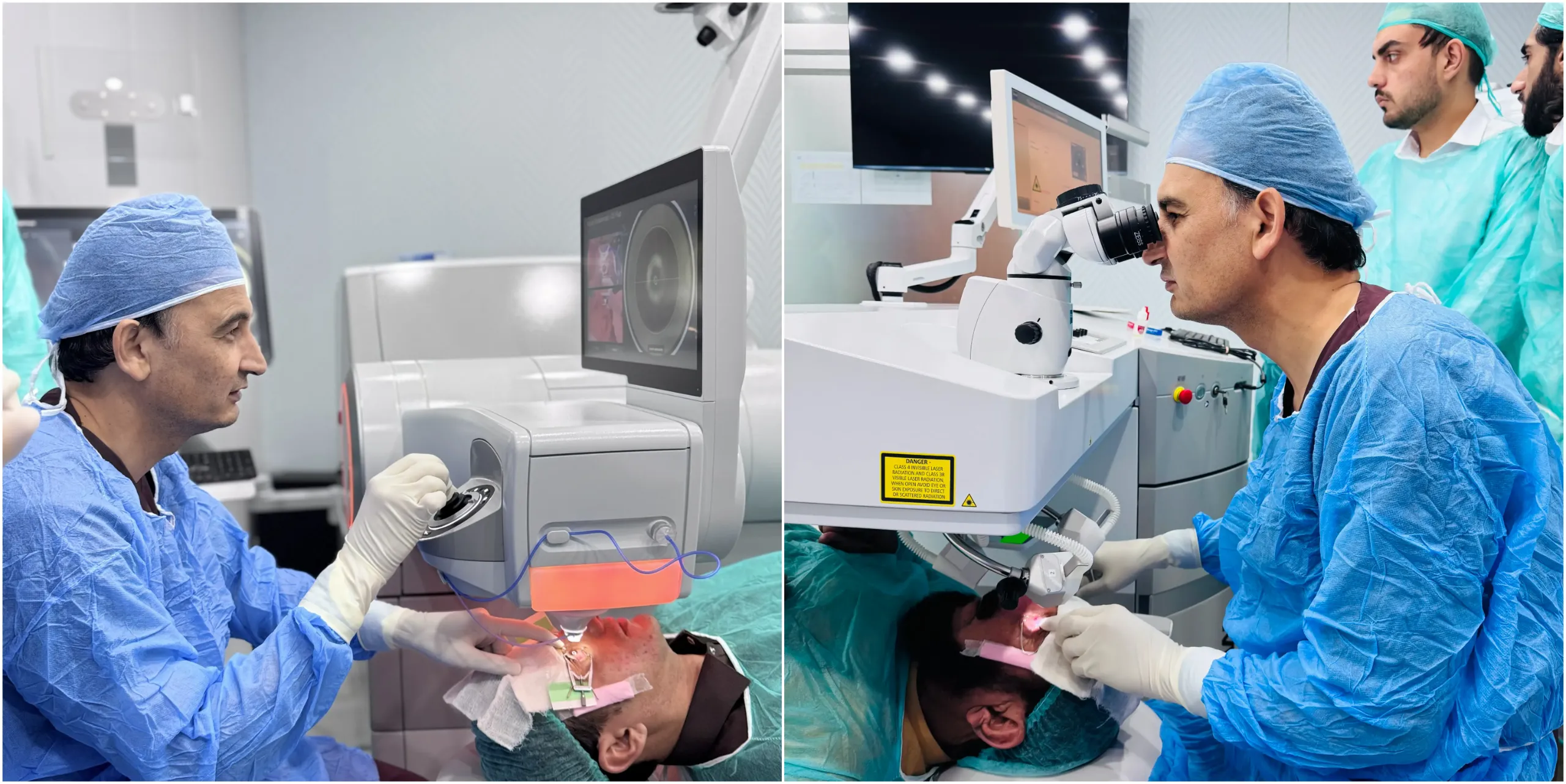
Patients in Peshawar and across Khyber Pakhtunkhwa may have access to both laser vision correction options depending on their individual suitability. At DR NAEEM Eye Laser & Retina Center in Peshawar, patients can undergo a comprehensive assessment before discussing whether SMILE Pro, LASIK, or another vision-correction option is appropriate.
The assessment should consider your prescription, corneal topography or tomography, corneal thickness, ocular-surface health, and overall eye health. The goal is not simply to choose the newest procedure, but to choose the option that is appropriate for your eyes.
Frequently Asked Questions
Is SMILE Pro better than LASIK?
Neither procedure is universally better. SMILE Pro avoids the creation of a LASIK-style corneal flap and comparative studies generally show less early dry-eye and corneal-nerve impact than femtosecond LASIK. LASIK can treat a broader range of prescriptions depending on the laser platform, including some hyperopia. The right option depends on your individual eye profile.
Medical Sources & References
Key medical and technology statements in this comparison should be supported by the following sources:
- ZEISS — VISUMAX 800 technology and SMILE pro
- ZEISS — VISUMAX 800 with SMILE pro FDA approval information
- U.S. FDA — VisuMax SMILE indication and labeling
- PubMed — Systematic review and network meta-analysis of SMILE and FS-LASIK corneal nerve outcomes
- PubMed — Systematic review and meta-analysis of dry-eye outcomes after SMILE/KLEx versus FS-LASIK
- PubMed — Meta-analysis of dry eye after SMILE and femtosecond LASIK
Medical Disclaimer
This article is provided for educational and informational purposes only. It does not replace a comprehensive eye examination, diagnosis, or individualized medical advice from a qualified ophthalmologist. Suitability for SMILE Pro or LASIK varies from person to person, and no online comparison can determine which procedure is appropriate for your eyes.
SMILE Pro or LASIK: Which Is Right for You?
The best way to decide is to compare your prescription, corneal measurements, eye health, lifestyle, and treatment goals with an ophthalmologist.